
Secrets of Successful Syndication
Tired of waiting for someone else to create a job for you or give you a raise? Take control of your own future by discovering how to make big money doing big deals through real estate syndication.
Syndication is simply putting together a group of investors and use the combined resources to take advantage of more and bigger opportunities for everyone’s benefit. And when you’ve fully deployed your own cash and credit, syndication is a great way to keep going.
Now is one of the greatest times we’ve seen to become a real estate syndicator. Distressed properties and notes are abundant. Assets can be purchased for pennies on the dollar. Best of all, you’re not preying upon the unfortunate. You’re helping clean up a big mess and playing a vital role in revitalizing the economy.
With all the liquidity being pumped into the economy, there’s still time to take advantage of low interest rates. Longer term, many economists expect inflation – which means rising asset values (equity!), rising rents and rising interest rates. But inflation hasn’t hit real estate yet, so there’s a window of opportunity to snap up deals.
We could go on and on about why the next 2-3 years look to be among the best ever to be a buyer. But that’s not the point of this article and we’ve discussed it many times on the broadcast.
The real point is that syndication is a great opportunity for sharp, hardworking people to become real estate entrepreneurs. In his new book, The Sleeping Giant, best selling author and Robert Kiyosaki Rich Dad Advisor Ken McElroy says a new American Dream is upon us: the age of the entrepreneur. Gone are the days of working four decades for the same company and retiring on a comfortable pension. And the last time we looked, Social Security isn’t looking very secure. So you need a good paying job now AND a way to build up wealth over the the long term.
If you’re unemployed, under-employed or concerned about the future of your job or company, then you might want to give serious consideration to starting your own business. And while there are many different businesses to choose from, in most all cases you’ll need to organize capital to get started. For the average Joe, that means using up his life’s savings, home equity and all his available credit card lines – literally betting the farm on the success of the business. That’s one way to go.
On the other hand, wouldn’t it be better if you were or raise some private investor money where neither you nor any of your investors are ruined if things don’t go as planned? Shared risk and shared reward. That’s all a syndication is.
Of course, that begs the question: what kind of a business?
Obviously, we like real estate – and for many reasons. First, it’s everywhere and not overly complicated – at least compared to starting a bio-tech firm or a software company. That makes it possible for you to get up to speed and run the business effectively pretty quickly. But it’s also a business that your investors should be able to understand and get excited about without needing Ph.D.’s.
Most people can see there are bargains galore in real estate right now, but because the dollars are big they can’t take advantage of them…by themselves. They don’t have enough money, time, knowledge or connections. That’s why so many people buy mutual funds instead of picking their own stocks. They are effectively hiring a fund manager to do the hard work of investing.
When you organize a real estate syndication, your investors are essentially hiring you to buy, manage and sell the investments – just like a mutual fund manager. Except instead of investing in stocks, you’re investing in real estate or notes. Now before you freak out, remember that you’ve probably already bought or sold a property, rented a property, gotten a loan or otherwise been involved in some real estate transactions. So you already have some experience. And if you’re a real estate agent, loan officer, appraiser, contractor or someone who deals with the business of real estate on a daily basis, you’re way ahead of the curve. Remember, most mutual fund managers don’t have to know how to run the companies they invest in, they just have to know how to recognize good business models and managers.
Of course, in the spirit of full disclosure, if syndication were THAT easy, then everyone would be doing it, right? True. However, we bet there are many very capable people out there who would be very successful syndicators, but it never occurred to them they could do it. And like any manager, it’s a huge responsibility to be in charge of other people’s assets. Yet, many people do a fine job for their employers every day, but just don’t think of it as asset management. Yet if you’re a manager of any kind, you’re responsible for someone else’s assets - their money, their customers, their reputation, their property, their information – on a daily basis. If you do a good job there, the odds are good you will be successful in real estate – which is quite possibly a lot less complicated than your current day job.
Still, it’s important to be properly trained. And the task of organizing an investment syndication is not one to be taken up lightly. There are laws to follow and lots of details to be aware of. Again, if it was brain dead easy, than everyone would be doing it.
So where can you go to learn the secrets of successful syndication? You can and should read books, take classes, and get around people who are doing it. Much of which you can figure out on your own if you have the time and motivation. But if the gap between where you are and where you want to be looks to big to jump on your own, we have something for you!
We’ve imposed upon our outstanding Investor Summit at Sea™ Faculty, which includes Ken McElroy and fellow Rich Dad Advisor Wayne Palmer (a very successful syndicator in his own right), plus international real estate developer Beth Clifford and attorney Mauricio Rauld, to conduct an all day training called The Secrets of Successful Syndication Seminar on April 3rd in Fort Lauderdale, Florida (you’ve been looking for a great reason to visit beautiful South Florida, right?).
Discover what it takes to organize and operate a real estate syndication business, where you can go from zero to a full time income (even part time!) in six months or less.
For more information and to enroll on-line, click here now.
The Real Estate Guys™ Radio Show podcast provides education, information, training and resources to help investors make money with their real estate investing.
7/25/10: Entrepreneurs in the New Economy – Getting Paid to Solve Problems
Do you remember the old “new” economy? That was the one where technology companies could go public without profit. In some cases, they didn’t even need revenue. Ahhhh, those were the days.
The new “new” economy (the Great Recession one) hasn’t been nearly as fun – unless you’re an old school entrepreneur. That’s the kind who looks at problems as opportunities. Guys (and gals) like that are having a lot of fun right now because there are opportunities galore coming out of the Great Recession.
The Real Estate Guys™ headed off to Freedom Fest in Las Vegas a few weeks back. We heard that money manager / economist / author / Senate candidate Peter Schiff would be there (among many other people with very strong opinions about the U.S. economy) and we wanted to do some interviews. We’re happy to report we got lots of great stuff, including Mr. Schiff and the CEO of Forbes Magazine, Steve Forbes. Watch for those interviews in future broadcasts.
So we fly into Las Vegas in our private jet (the one operated by Southwest Airlines), and get to the convention venue and start setting up our booth. Before the event had even started, a man stops by and sees our banner for Belize (we were promoting our upcoming field trip to Belize) and asks a few questions. The short of it is that we find out he’s working on a very exciting project in the Caribbean – one that solves a problem we’ve been trying to figure out too. Russ gets so excited that he hugs the guy. Very weird.
After the appropriate apologies and some follow up male bonding, our new friend agrees to do a radio interview. And that’s what this broadcast is all about.
Manning the microphones for this edition of The Real Estate Guys™ Radio Show:
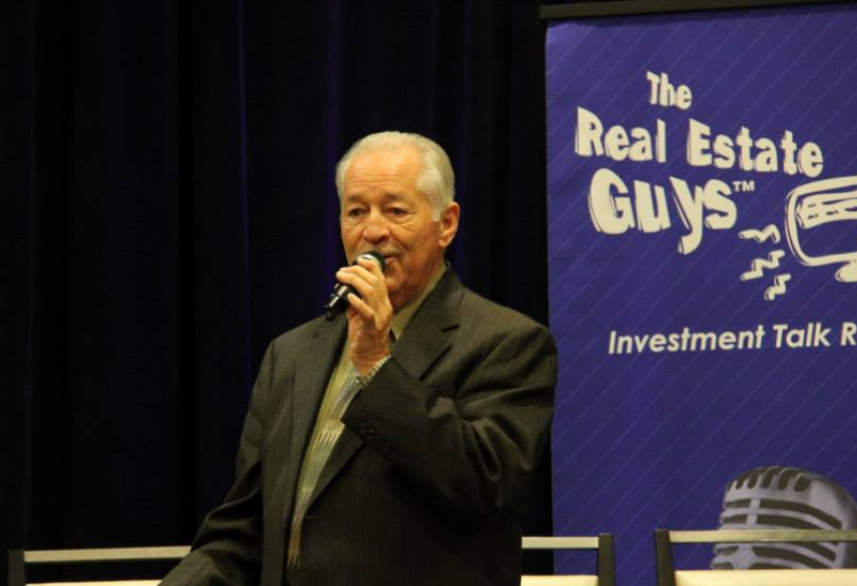
- Your host, the Larry King of real estate radio, Robert Helms
- Co-host, our “I love you, man” booth babe, Russell Gray
- Special Guest, Investment Banker, Entrepreneur and assault victim, Jeff Villwock
Any time we get around smart people, we jump on the opportunity to talk with them. In this case, Russ literally jumped on Jeff. When Jeff recovered, we got him on the mic, so you can listen to what he’s doing, where he’s doing it and why. There’s lots of lessons to be gleaned!
Freedom Fest is an event that attracts people with strong political opinions. In many of the interviews we did there, those opinions come out. Great! We think the world works better when people respectfully debate important issues. Sharing ideas is among the most sacred of our freedoms, especially if you’re radio guys.
We also realize that the U.S. (the bulk of our audience) is pretty polarized right now. Now, we love our entire audience and our show isn’t political. However, policies affect economics and economics affects real estate. There shouldn’t be a serious student of real estate who can look at the last several years and deny that. So politics are going to get into the discourse from time to time, which is a very good thing.
We think these Freedom Fest interviews are great. If you disagree with the political views of our guests, don’t let that get in the way of hearing what’s being said. Here’s why: a big part of real estate investing is understanding demographics and human nature. How people think and believe affects where they (and their money) will be moving. Even if you disagree with them, if they believe it, it will affect their actions. So YOU need to understand them (even if you disagree) if you want to anticipate their behavior.
Did we mention that Jeff’s project is in St. Kitts? It just so happens that St. Kitts is one of the stops on our upcoming 9th Annual Summit at Sea! So we ask Jeff if we can visit his project as part of our already planned real estate shore excursion in St. Kitts. Not only does Jeff agree to allow us to visit, he says he’ll meet us there and show us around. Awesome!
Once again, we’re reminded of the importance of getting out of our cubicles and into the world where real people are. No doubt that virtual networking is powerful, but just as phones did not replace face to face meetings, neither will social media replace conventions as a great place to make important connections. This is one of the reasons we attend trade shows and promote our field trips and the Summit at Sea™. It’s a great way to get to know great people in the real world. We hope to see YOU at one very soon!
Listen Now
Don’t miss a show! Subscribe to the Free Podcast
Want More? Sign Up for The Real Estate Guys™ Free Newsletter!
Problem or Opportunity?
Sorry – not a particularly catchy title for this post – but it’s still an important concept that merits reinforcement. In Equity Happens, we talk about how real estate investing is a business of fundamentals. When you master the fundamentals, then you master the business. In this case, the fundamental we’re talking about is one’s attitude towards “adversity”.
Watchers, victims, people who are waiting for “someone” (like the government) to do “something” see adversity as a problem. “Oh my gosh. There’s a big problem. Someone needs to do something!”
Doers, entrepreneurs, capitalists (you know, the people the government likes to take money from to fix the problem while often blaming them for causing it – oops, didn’t mean to let that slip out) look at adversity and say, “WOW! What a great opportunity! Everyone is crying in their soup, brain-locked with fear and unwilling to act. All I have to do is be creative and bold, and I can convert this adversity into an opportunity!”
Case in point: Today, the Wall Street Journal reports that real estate developer Young Woo is planning to convert the top 40 floors of AIG’s 66-story building into luxury condominiums. The Journal reports that Woo bought the distressed building (though actually, it was the OWNER that was distressed, not the property) for $150 million or $105 per square foot. If you don’t know, that’s cheap. He couldn’t build it for that.
After conversion, Woo hopes to sell the condos for close to $2,000 per square foot. Even after all his expenses, he could realize a profit of $500 per square foot or roughly $600,000 per condo! Not too shabby.
Of course, the plan looks good on paper and Woo has to actually execute the plan in order to realize his profit. But that’s what America and real estate is all about.
You may not be ready to take on a 66 story conversion project, but the principals apply at any level. The marketplace is full of distress and adversity right now. That means there are lots of opportunities IF you can see them, and IF you have the courage to lead.
Think and DO is better than Wait and See.
Start with education. Learn the fundamentals. Watch other investors. Learn from their successes and mistakes. Build relationships with experts you can call on when you’re in the middle of a deal. It’s always good to get lots of brains on the problem. But remember, it’s YOUR money and YOUR opportunity, so do NOT wait for someone else to empower you or assure your success. When you’ve done your homework and you see your opportunity, then YOU make the call – and go make equity happen for you.